In the lower-left corner of our Gameboard for Life, we enter the cornerstone of the modern age: conceptual order. It's our invisible operating system forged from information, rules, and technologies that stabilize and empower us.
Each day, we make sense of our messy human experiences with conceptual patterns — rules, facts, and explanations that apply not only in a particular instance but others like it. From these, we build habits, knowledge, routines, technology, and skills that stabilize our work and lives.
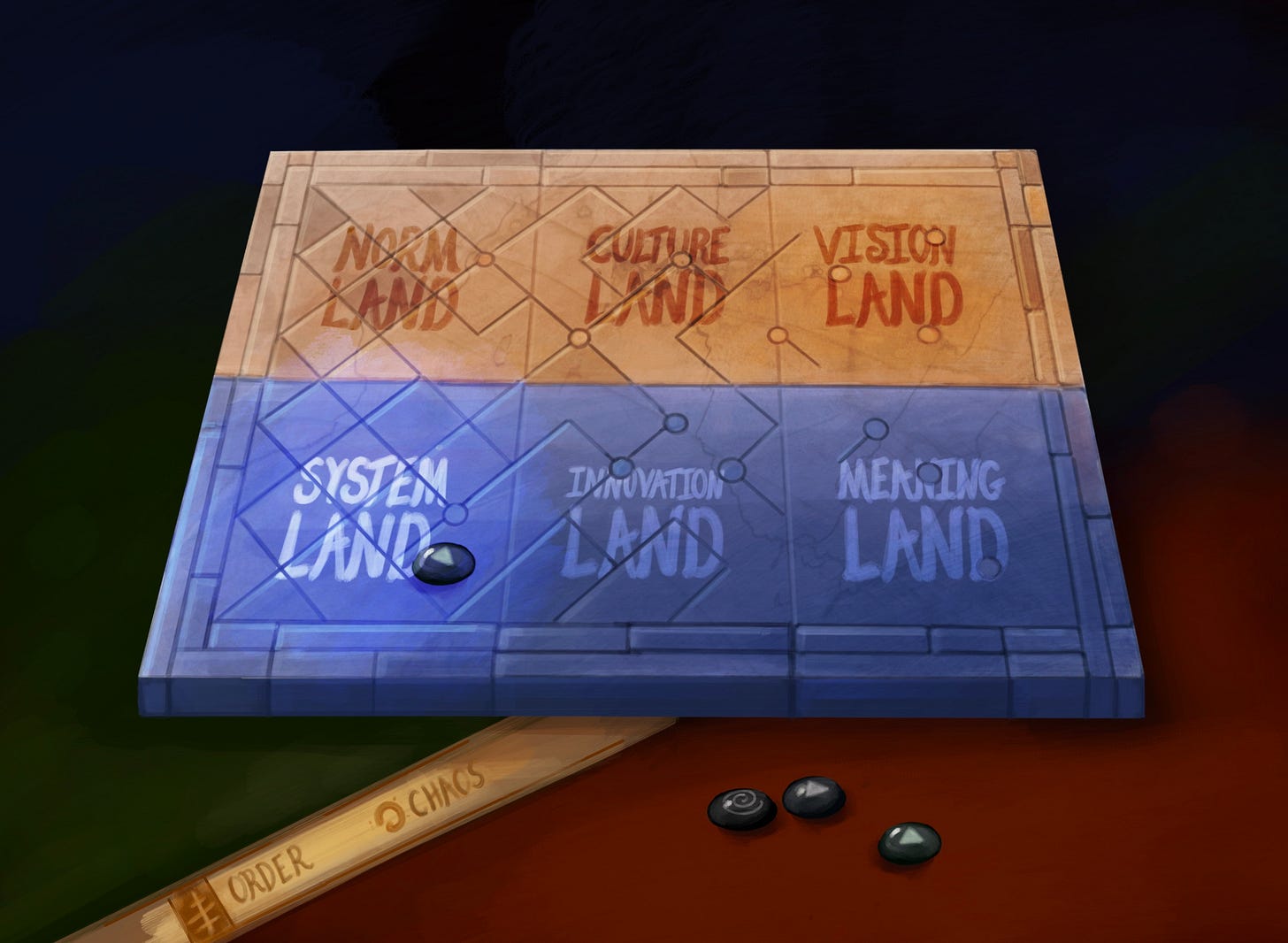
Systemland isn’t flashy, but contains a human superpower: with it, we can wield concepts that organize, predict, and manipulate the world without having to act in it directly. We can act beyond instinct and our life spans with a God-like ability to reshape the world with words, whether they be laws, coded instructions, or information.
You, your team, and society have a conceptual order. We navigate it implicitly well enough most of the time. But thinking of it as a mental place with different rules from other spaces1 helps us play the game of life and work more consciously and productively.
The less robust our concepts, the more we rely on relationships to hold ourselves together: a web of traditions, norms, and social hierarchies navigated and upheld by feelings, not logic. But the plays in Normland — Remember, Preserve, and Place — only get us so far and may quickly flip to socially punish us. Systemland expands our deck with Plays that counter and support the more volatile and dramatic social world above.

Millennia of blundering misconceptions yield a few that work: red berries make us sick, but these blue ones are tasty; sowing seeds in this soil at this time helps us survive the winter; power corrupts, and absolute power corrupts absolutely.
More often than not, the seed for a new tool or rule is a desperate need to disembody an insufferable pattern in our relationships with ourselves or others:
- We observe functional or dysfunctional patterns in Normland in all their dramatic, human messiness.
- Then we apply logic, methods, and tools to distill abstract patterns from these sensations.
- We try our shiny new abstraction in real life to see if it gets better or worse.
This cycle gradually evolves primitive practices into robust science, technology, and government.
Abstracting away from lived experience is appealing, especially for people who enjoy thinking or tinkering away from other people's drama.
“Simple rule often forgotten. Objects are consistently predictable. People are consistently unpredictable." — Juvoni Beckford
But dwelling too much time in Systemland comes at a cost: if we aren't careful, we may abstract ourselves right out of our community. ABSTRACT can quickly flip to a darker play: DETACH2.
A significant and misunderstood difference between us and others is where our mental energy naturally flows: into abstractions (conceptual patterns) or toward people (relational patterns). We play in both realms, of course, but tend to have as strong of a preference for one space as we do for writing with our left or right hand.
For some, abstractions are fascinating, and people are only as interesting as the concepts we can explore with them. For others, the opposite: concepts are only as interesting as the people they connect us to.
Those of us whose minds jump to the abstract first are naturally more individualistic; abstracting requires solitary, impersonal thought. So it’s no surprise that science, tech, economists, and other concept-fueled tribes tend to hold more individualistic worldviews.

Proving — and improving — an idea requires applying judicious logic with force, precision, and repetition until raw ideas are shaped into reliable mental tools.
The PROVE play ruthlessly pits our abstractions against each other to see which holds up when they encounter reality. And then we do it again and again. There’s no room for status games, social maneuvering, or feelings. "Does it work" is all that matters.
Ben Shapiro’s snarky rejoinder that ”facts don’t care about your feelings” typifies this Systemland perspective.3 It doesn’t matter what the King, Pope, or Dad says — whatever survived the forge of reason in the past is what we'll use today.
Common Law is one of the best examples of how conceptual patterns incrementally yank power from privileged elites or religious gurus and hand it over to more abstract, objective, and impartial ways of resolving disputes (at least inasmuch as relational patterns can be held at bay.) Meritocracy has had a similar impact on our career prospects and is systemized into credentials earned by standardized tests.
But proving everything impersonally and objectively in opposition to our felt experiences can flip to a darker side: DOGMATIZE4. Any worldview resting on cold logic will grow as rigid as any religious fundamentalist's while being simultaneously less nourishing or motivating.
Systemland players deeply believe that laying out the science, facts, and logic should be all people need to arrive at obvious conclusions. 2+2=4, right? But that’s a misplay for changing someone’s feelings and behavior, which are overwhelmingly more influenced by traditions, norms, and social structures — relational patterns, not conceptual ones.5
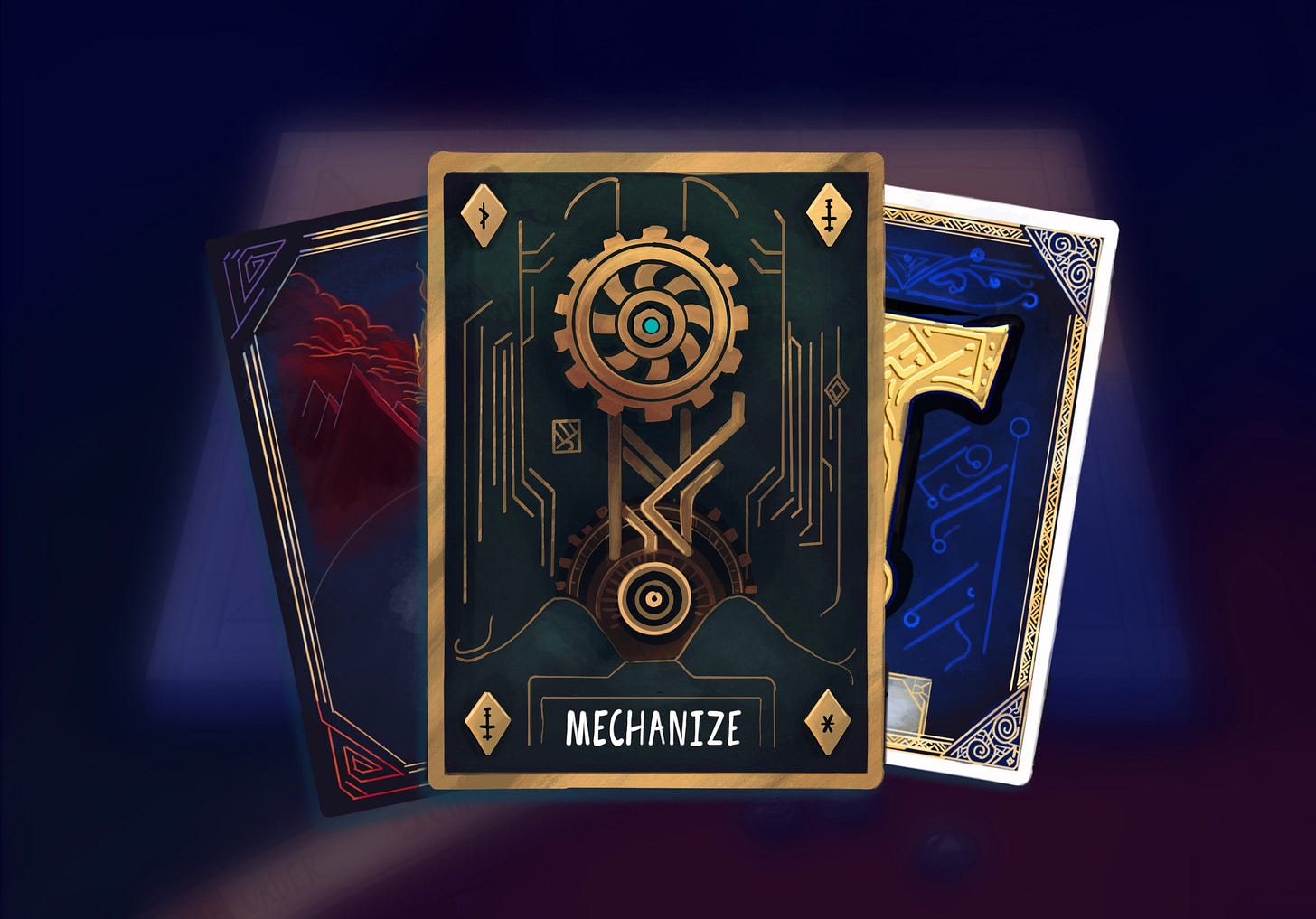
What do we do with well-honed, proven concepts? We build. We turn invisible thoughts into tools — software, devices, and machines — that transform our lives.
Clerks, bookkeepers, pharmacists, mechanics, financiers, and other knowledgeable specialists quietly keep the systems we depend on humming. It's an essential but thankless task: when it works, no one cares — when it breaks, everyone complains. The lack of notice — let alone appreciation — for those who maintain our conceptual order has created a looming infrastructure crisis in the United States.6
Playing MECHANIZE improves an overall system by making each part more specialized and independent. One company used to make whole cars, but now entire companies specialize in making individual parts assembled on a line; academics, technicians, physicians, and lawyers increasingly specialize in deep niche expertise. System specialization creates more scalable and varied products and economies but also has a dark side: the more we specialize, the more easily we REDUCE7 humans and knowledge into disconnected cogs in the machine. But then it gets worse…
Maintaining a stable team, family, or culture demands a sizable portion of our collective energy be spent on keeping what already works working. Entropy and decay erode knowledge, software, and organizations as much as stone or metal.
So change aversion is a feature of Systemland, not a bug. “If it ain't broke, don't fix it.” Check those half-baked futuristic visions or fuzzy ideals at the door, please, there’s enough real work to tend to. But this feature leaves players in Systemland vulnerable:
- Systemland work is generally undervalued — often underpaid and overlooked as a career path.
- But it’s ripe for automation too — the more precise, predictable, and systemized our work, the easier it is to outsource to machines and code that never tire, complain, or ask for a raise. Each wave of automation displaces swaths of human jobs.
- And here's the rub: people who gravitate to predictable, procedural Systemland work are necessarily more reluctant to adopt new tools and ways of thinking (again, a feature, not a bug). But the pace of change to adapt to — or be replaced by automation — is accelerating.8
Maintaining robust systems is essential, noble work — but unless we’re open to trading our current information, systems, and tools for better ones, we risk playing ourselves out of the game.
“What we achieve inwardly will change outer reality.” — Plutarch
Our personal and collective systems shape everything about our reality in ways we rarely notice. The work here isn't more glamorous than a tough calculus problem and equally difficult and thankless most of the time.
But the healthiest people and groups today tended to their systems before it seemed necessary. It takes discipline and work but gives us a serene stability that yields more freedom and resilience over time. We tend to our conceptual order when we:
- Do the painful work to dissect past failures and trauma that most are happier to forget.
- Resolve nagging issues that seem trivial enough for others to sweep under the rug.
- Religiously use tools and supportive environmental cues to stick with our habits.
- Pace ourselves and take breaks while others hustle.
- Do our chores.
Here are a few ideas to think about:
- Body: healthy eating & exercise habits, checkups, a routine sleep schedule,…
- Mind: routine rest, planned boredom, reading to learn, meditation/prayer, time to reflect, memorization, rigorous research, journaling,...
- Family: budgeting, home/vehicle maintenance, shared schedules, defined house roles and rules, chores,...
- Work: schedule consistency, guarded time for solitary focus, actionable next steps, writing out thoughts clearly, defining expectations, cashflow management, setting deadlines and keeping them, usability tests, measuring performance, code reviews, postmortems,...
Now that you’ve got a concept or system you’d like to improve try intentionally applying one or more Plays:
- ABSTRACT: can you describe the goal, habit, or system precisely and comprehensively in writing? (If not, you may not have abstracted it enough from your feelings or intuitions to practically use it.)
- PROVE: have you validated that your understanding, plan, or belief actually works? What parts are debatable and what alternatives have you considered? Have you given it enough tries before giving it up?
- MECHANIZE: what tools (apps, methods, hardware) could you use to reduce or eliminate friction? For example, using an alarm clock to always get up at the same time, an app to track calories, or GTD to manage your daily tasks.
Northeast towards Chaos lies the idealistic and revolutionary Cultureland.