Personality models like MBTI bring order to the chaos of understanding where people are coming from and what in the world they're up to.
In this essay, we’ll pull pencil to paper1 and sketch a Personality Map of perhaps the most popular personality model in modern times: The Myers Briggs Type Indicator (MBTI).
We'll begin by mapping one of its four dimensions: “Thinking” and “Feeling.”
No matter what you think or feel about the MBTI, I hope that visually sketching around it gives you a helpful perspective.
(You can continue sketching this Personality Map in The hidden gap in the way we see things.)
The MBTI describes two functions for a core part of anyone's personality — Feeling and Thinking:
"A basic difference in judgment arises from the existence of two distinct and sharply contrasting ways of coming to conclusions. One way is by the use of thinking, that is, by a logical process, aimed at an impersonal finding. The other is by feeling, that is, by appreciation—equally reasonable in its fashion—bestowing on things a personal, subjective value." 2
This rather bland introduction introduces two important ways to think of ourselves and others:
- Feeling if we tend to find our spark in relationships with others: food and friendship, feelings of group harmony, individual wellbeing, expression, arts, and culture. Healthy feelers come across as warm, caring, and pleasant. They tend to be sensitive to what's “alive” in people around them and within themselves.
- Thinking if our interests move more towards concepts first – impersonal, ideas, systems, and information. Healthy thinkers come across as rational, objective, and steady. They’re usually less aware of emotions and prefer to hone in on abstractions in their minds.

Sketch: Given two boxes — one for Thinking and another for Feeling — how quickly could you sort the first three people who pop into your head in one or the other?
I'd guess it’ll be a few seconds for most of you. Sorting people this way isn't exactly novel — all popular personality models from the scientifically-valid “Big Five” to Harry Potter Houses include traits or types easily placed in MBTI’s Thinking or Feeling box.3
But there's a much older people-typing instinct in play: our ancestors in most corners of the world personified Thinking as "masculine" and Feeling as "feminine." Tethering a psychological disposition so closely with physical appearance means we often subconsciously place people in a box rather than considering them as a person first:4
- This one looks masculine, so we assume they're more rational, objective, and steady.
- This one appears feminine, so we expect they'll be more nurturing, caring, and emotional.
(To state the obvious: this is a less than ideal lens for understanding people.)
Thankfully, any personality model provides an alternative to skin-deep stereotypes.5 They enable anyone — of any appearance — to be understood as first an individual.6
But this upgrade comes with a trade-off: models designed for individuals are individually useful. What we gain in our sense of individuality, we lose as a way to understand ourselves as part of a social whole.
We lose sight of how people and circumstances continually shape our Thinking or Feeling and that sometimes they need more of one or the other from us regardless of our type.
So what to do? I suspect the way forward isn’t to retreat back to tribal views or to evolve new subjective social identities. Nor is it to abolish or double down on objective classification and measurements.
Rather, we need to evolve our models and tools into a third way that helps us navigate the social and individual aspects of ourselves more easily.
The Chaos Map is partially an experiment to see how translating mental models like the MBTI into meaningful, visual space helps us navigate not only ourselves but the other people and forces in our environments.
Are we at work, at home, in a class, or in a religious group? Comparing ourselves to the culture at large? Our frame of reference is relative, not fixed — we may be the most Feeling in a team of engineers and the most Thinking in our poetry circle.7
So let's start by tracing the borders of our Map thinking of a particular context. Think of any group you'd like a clearer picture of.
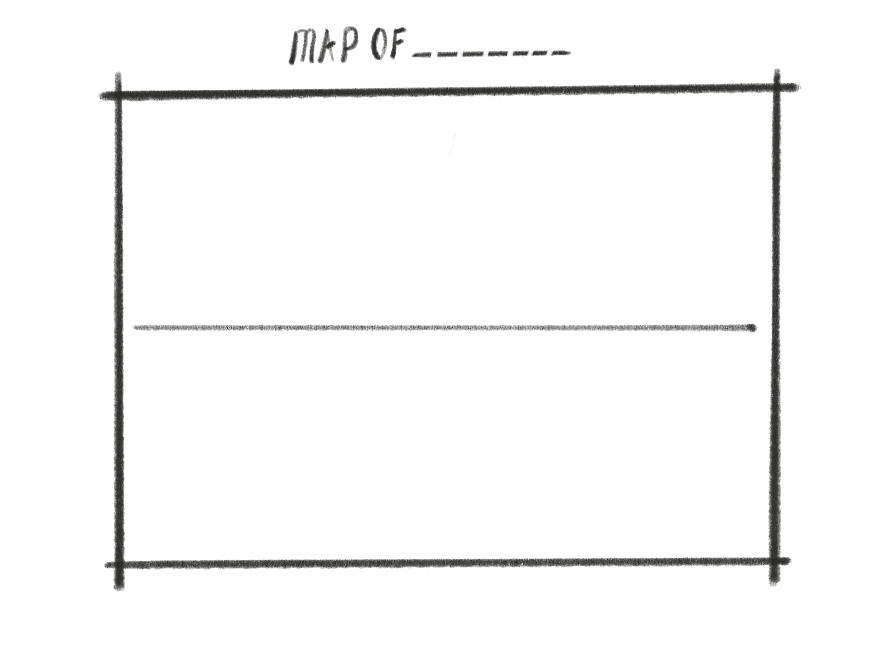
(You'll be able to build on this map in the following essays mapping other dimensions of the MBTI.)
The Chaos Map reframes Thinking or Feeling traits as two worlds of mirror opposites.
- Relational World: This above-the-surface world contains subtle, rich patterns of connection and possibility between humans and the things we care about. Within it, we form living patterns that connect us with others, ourselves, and the transcendent. It's where we tend to physical and emotional needs, enact cultural rituals, make art, buttress or tear down social norms, form tribes, create narratives, and more.
- Conceptual World: The world hidden below the surface is where we make patterns of knowledge, technology, and laws from the chaos of everything we don't yet know. These abstract, impersonal concepts reflect, root, and empower our lived experience above.
These mirror worlds are as integral to each other as leaves and roots and every bit as different too. Treating them alike works as well as playing chess while performing jazz, enjoying a movie in a spreadsheet, and most politics.
Whatever our map, we all move between these worlds depending on the circumstance, like a player on a field or stage:
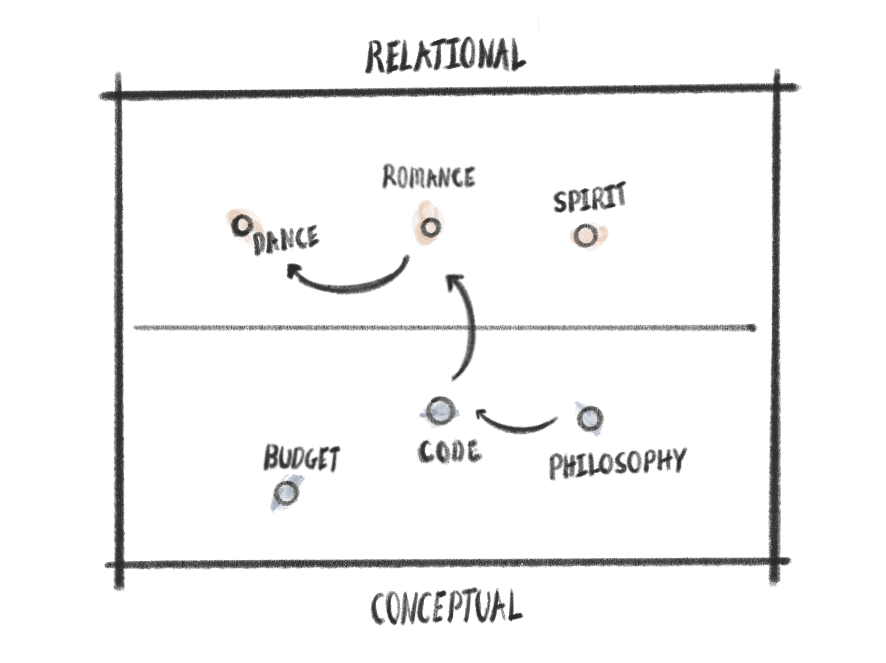
Sketch: What patterns and possibilities live in your map's Relational or Conceptual Worlds?
From infancy onwards, our psyche forms patterns that order whatever kind of chaos our environment and disposition place us in.
These patterns grow more stable, complex, and powerful the more we use them, forming well-worn paths in our psyche. Eventually, they become our starting position on the field, the type-casted character we like to play, our “personality"; (But they aren't us.)
Reflecting on your map, what patterns and possibilities do you tend to use most?
In contrast, a personality model like the MBTI reduces these pattern paths into a category and percentile. The last time I took the test 8, I scored:
- Thinking: 81%
- Feeling: 19%
While the theory and advice from the MBTI are more nuanced, the output implies I'm precisely that way. A map helps me depersonalize my personality to see a wider landscape of human experience.
Visualizing relational or conceptual patterns as spaces — not personalities — opens up a more flexible, adaptable approach to life and work. Here's an example I’ve found helpful to visualize:
Let's say we notice that a coworker we care about is visibly feeling burned out and is struggling to make progress. Our mind starts looking for patterns like:
- Relational: Missing human connection, feeling undervalued, lacking self-care time, being mistreated,...
- Conceptual: Too much of a workload, misaligned tasks with skill or interests, is stuck on a problem, has unrealistic goals,…
If our minds immediately head down our own preferred pattern path to a resolution, it's easy to make a misplay I've made too many times:
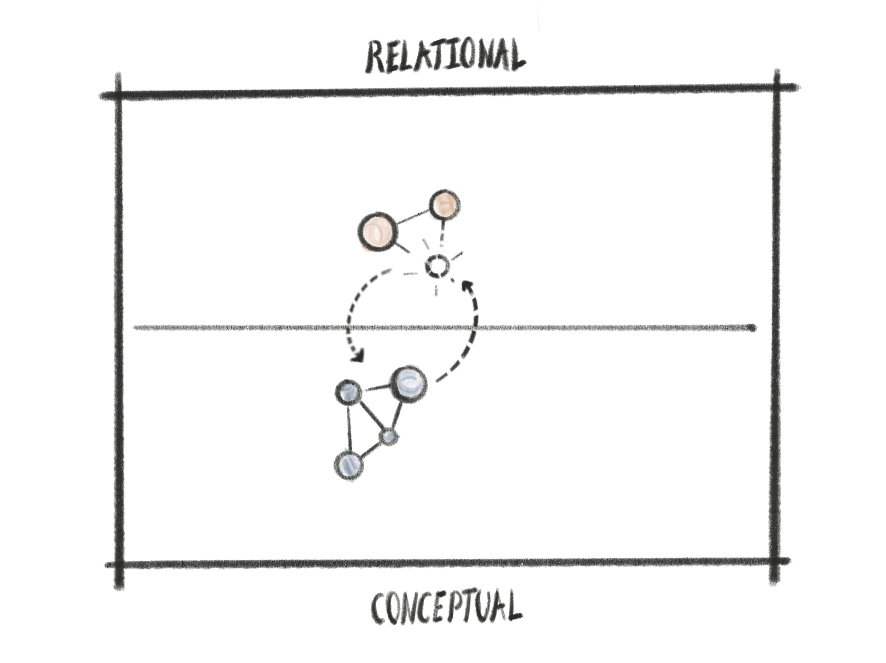
A common misplay from mistaken patterns.
The misplay goes something like this:
- Someone signals a gap in relational connection — uneasiness about where we stand, latent fear of weakening or lost connection, a disordered or damaged relationship. It's clear in hindsight, but the moment it’s forced into my attention...
- …I pick up my familiar patterns in the conceptual underworld and put them to work: Where's the glitch in the system here? What are the gaps in information or rationale? Perhaps we need a different paradigm?
It’s impersonal, abstract, and as effective as mixing oil and water.
All that when a move into the Relational World first with a word of appreciation, time to listen, share a meal or hug could have mended things.9
Pattern Matching is a play I'm learning to make:
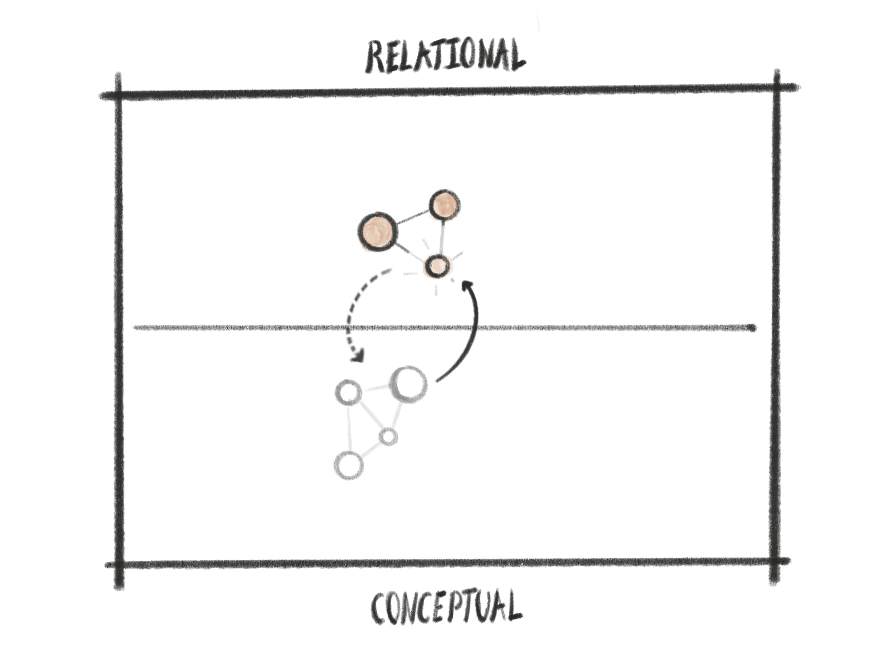
Strained or broken relational patterns can only be mended by relational means (And the same applies to conceptual patterns, of course.)
Now, most of us don't need a map to indicate we’ve made misplays between Thinking and Feeling. It’s a one-dimensional screw-up that’s easy enough to see in theory, if not avoid in practice.
That said, I’ve found that taking just a moment to visualize the kind of patterns I’m playing in helps me meet people where they are, not where I am, more often. Sketching it doesn’t fix anything, but gives me space to plan a route into foreign territory.
In the following essay, we'll add a second dimension to our map that'll make things more interesting: MBTI’s "Sensing" and "Intuition".
This spectrum provides a horizontal axis to our Relational and Conceptual worlds and unlocks more clarity and possibility. I'll share a few more plays I've found helpful as we go, including "Map the Trip" (the visual mindfulness technique) and "Give and go."
Meanwhile, I’m curious to hear of any plays you’ve found useful in navigating between Thinking and Feeling spaces?