---
title: Why most meetings are a waste of time
description: In this field note, we'll apply a few ideas from the Chaos Map to
sketch a clearer picture for where meetings fit and don't fit in creative,
collaborative work.
contentType: fieldnote
image: /images/illustrations/img-f620177ead9c-light.png
---
[@layout]: ../../layouts/reading.layout.md
[@page]: ../../design/page.components.md
[@reading]: ../../design/reading.components.md
# Why most meetings are a waste of time
---
Extroverts and managers tend to call meetings, while introverts and creative workers tend to avoid them. But a better approach for deciding whether or not to hit send on that calendar invite is to picture the shape of the work we're collaborating around.
A good question to start with is: *Are we exploring or making progress?*
---
## Small meetings help us explore and map ideas
When we're stuck on a problem or onto a new idea, a conversation is a great way to work it out.
Great conversations naturally flow in a [spiral](/#spiral-motion) as we overlay our mental map with someone else's in real-time. Each response and reply merges, diverges, and bounces our thoughts into new directions while integrating prior points and ideas.
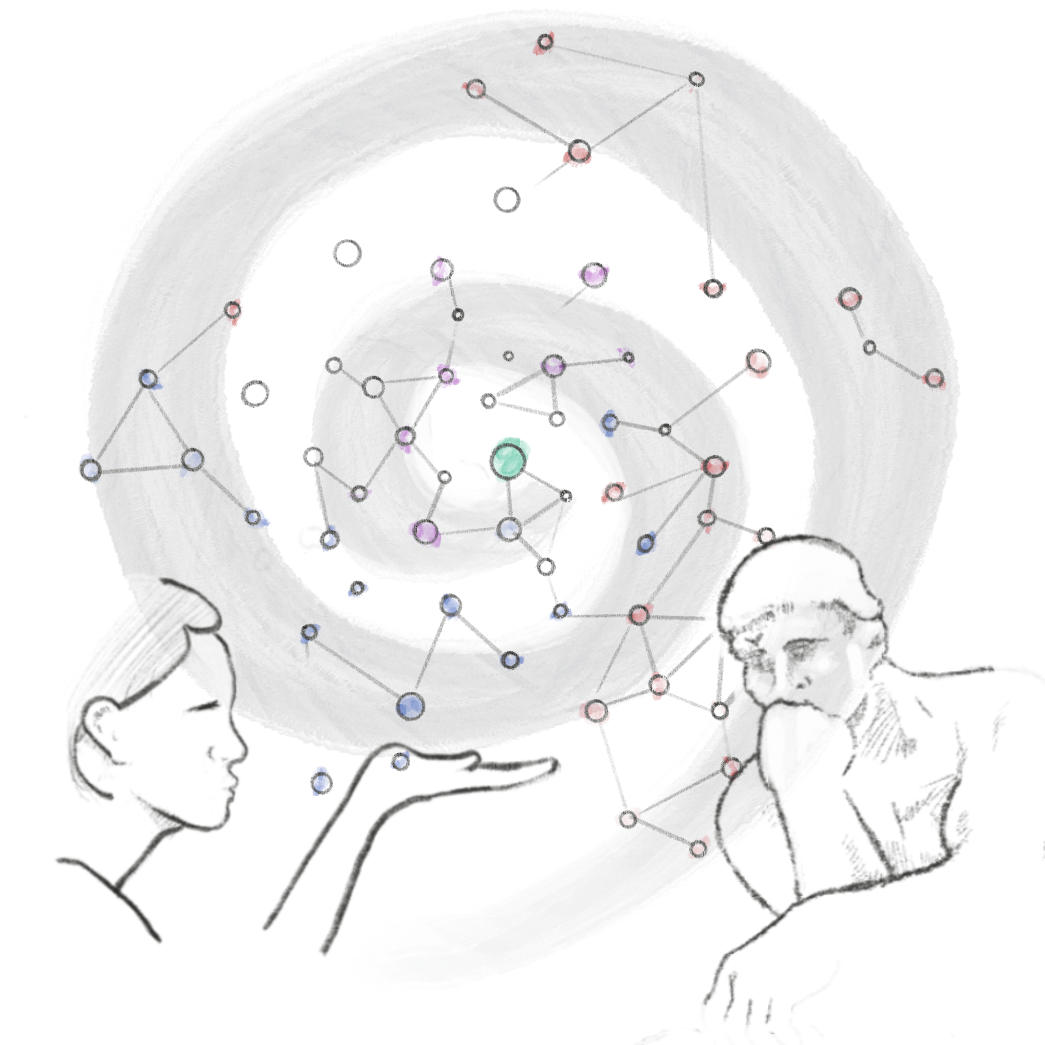 Together, we map a clearer, more comprehensive picture of the problem space like a radar scanning territory in increasingly high definition. A good conversation generates possibilities neither participant would have dreamed up on their own.
Exploratory conversations are best when we:
1. **Keep them small**: More than two or three participants clouds the conversation space with too many ideas to navigate and forces people to compete for air time. (I suspect this is why podcasts tend to include only two or three people.)
2. **Do our homework**: Good conversation partners show up with enough of their own thoughts around the topic for us to connect with; unprepared participants tend to stab in the dark or suck energy away as others attempt to get them up to speed.
---
## Meetings disrupt progress
When we're no longer stuck on an idea, we shift our focus towards making it happen – implementing decisions, reaching a milestone, clarifying the next step; but in this phase, the spiral nature of conversations works against us.
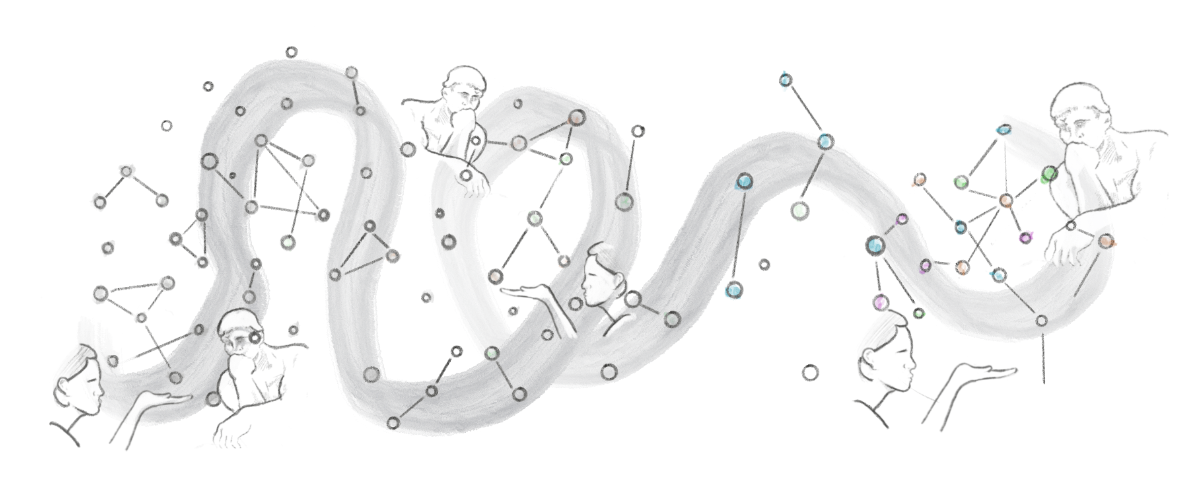 Delivering decisions, instructions, or details about work in a meeting guarantees it won't survive intact when it's needed days, weeks, or months later (and these kinds of meetings are so tedious we're lucky if the information survives the hour).
---
### The meeting-dependence addiction cycle
1. An initial meeting overloads the team's mental inventory, naturally leading to confusion and missteps down the line.
2. A "manager" steps in to clear things up by… calling another meeting. They repeat this step every time things go off track.
3. Eventually, our work days are filled with morning stand-ups, "quick" chats, and project status meetings leaving little time for the actual work.
4. With so little time, we neglect to carefully create or respond to more easily referenced and less interruptive communications like emails, docs, and shared to-do lists so they're of little help.
5. We hire more managers to improve productivity... and they call more meetings.
---
## A just-in-time approach to collaboration
As we bring a measure of chaos to order, momentum depends on referencing relevant decisions and details when and where we need them: as we design, code, write, present – no sooner, no later, and with as few interruptions as possible. We need to move together more like an [arrow](/#arrow-motion) than a spiral.
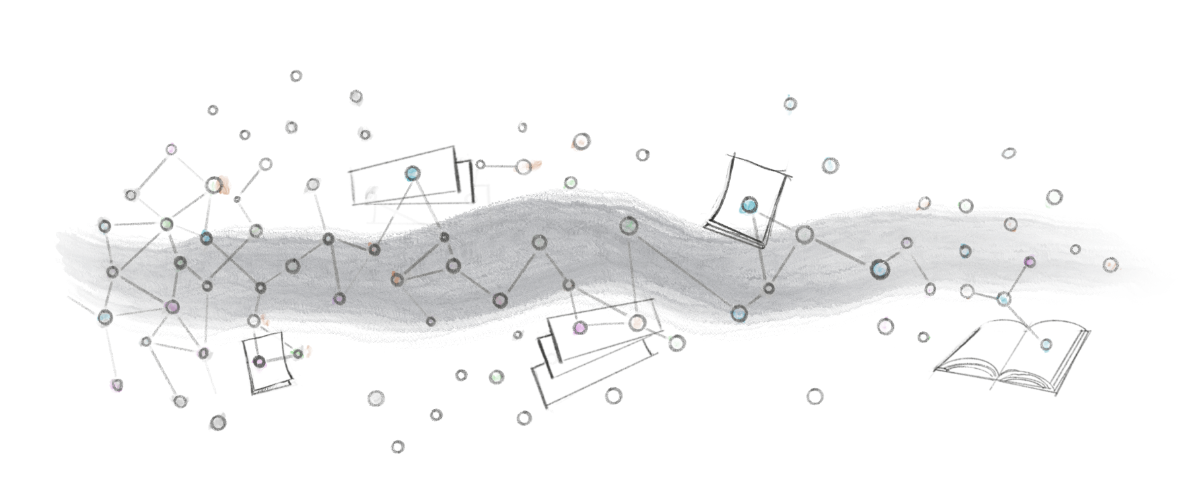 Modern technology provides simple tools for transporting essential information to the future via an assigned to-do, written post, or video that's easy to reference just as it's needed. It's the knowledge work equivalent of the "just in time inventory" model that gave Toyota a competitive edge and transformed the auto industry.
Meetings are good fits for exploring and mapping ideas but unfit for making them happen.
---
## But what about relationships?
In my twenty-plus years of meeting colleagues and customers, I've found that the leading cause of meetings is that people who really like talking with people schedule them.
Extroverts enjoy meetings as a means to create new or deeper relational connections. And as much as the introverted part of me dislikes it, I have to admit *they're right.*
Something about the extemporaneous nature of a conversation reveals more about us than a recorded, edited version of our thoughts alone can approach. Perhaps it's partly because...
- we're more expressive and vulnerable when we're looking at someone and know our words aren't recorded.
- we pay closer attention when someone's looking at us and there's no rewind button.
These ingredients heighten our sense of *the present* and *presence* to generate an energy we can't access in a memo, design, or video.
In face-to-face conversation, we're also more likely to discover shared interests, pick up on unspoken clues as to what's *really* important to someone, and uncover their unique quirks. All those little details give us a clearer pattern of our colleague as a unique person and open up more ways to connect with them.
In the long run, more relational connections make collaboration on any kind of work more fun and more productive.
---
## A dilemma
If there's a playbook for collaboration that's very productive *and* fosters great work relationships, I haven't found it. But I think achieving both is important and possible with enough creative experimentation.
My [team at Pathwright](https://www.pathwright.com/humans) holds very few meetings about day-to-day work and we don't use chat apps like Slack. Overall, it's a calm, creative, and productive place to work.
Without as much real-time communication, we're always experimenting with other ways to connect more as humans. Here are a few things we've found helpful that perhaps your team might as well:
- Encourage focused exploratory conversations in small groups.
- Take walking breaks, play games, and share meals together.
- Ask someone to demonstrate something they're particularly good at and discuss it. (Teaching and learning together is a natural way to get to know anyone better.)
- Share and discuss behind the scenes looks at future plans, bigger picture ideas, and side projects that are easy to miss in day-to-day work.
- We *avoid* meeting for the sole purpose of "team building" (that gets awkward fast.)
Mapping our collaboration methods (meetings, todos, posts, etc.) to the geography of work is new territory that's well worth exploring. I'd enjoy exploring your thoughts on it as well, [in a meeting](https://calendly.com/pauljohnson/chaosmap) or to reference as an [email](mailto:paul.johnson@hey.com).