---
title: Welcome to Cultureland
subtitle: "A tour of emerging relational order: the social vanguard that evolves
our communities."
date: 2023-03-03
published: true
source: chaosmap.substack.com
contentType: essay
series: A Game Board for Life
seriesOrder: 4
description: "A tour of emerging relational order: the social vanguard that
evolves our communities."
newsletterUrl: https://chaosmap.substack.com/p/welcome-to-cultureland
edition: annotated
series-order: 3
image: /images/substack/welcome-to-cultureland/1.jpg
---
[@layout]: ../../layouts/reading.layout.md
[@page]: ../../design/page.components.md
[@reading]: ../../design/reading.components.md
# Welcome to Cultureland
---
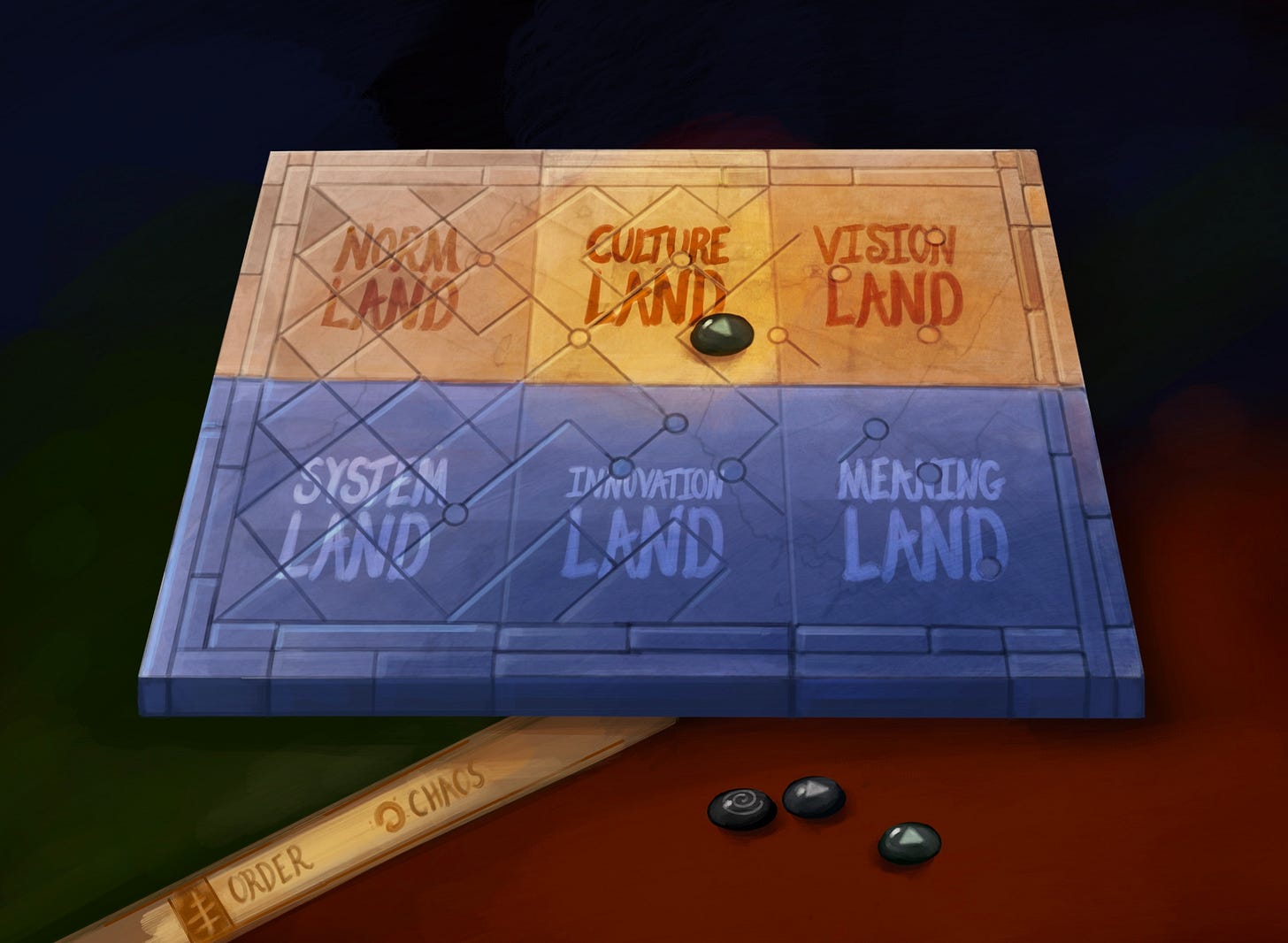
In this tour of the [Gameboard for Life](/series/a-game-board-for-life/index.md), we leave the safe shores of [@link(open=reference) Order](/concepts/order/index.md) and move towards the unknown potential of [@link(open=reference) Chaos](/concepts/chaos/index.md):
Cultureland: the middle space of emerging relational order.
Cultureland is a psychological space we enter as we zoom out to see the picture of a community’s relational [@link(open=reference) patterns](/concepts/pattern/index.md): its norms, traditions, hierarchies, and values. It gives us a felt, intuitive vision of how our community aligns with subjective values like justice, beauty, freedom, compassion, equality, etc.
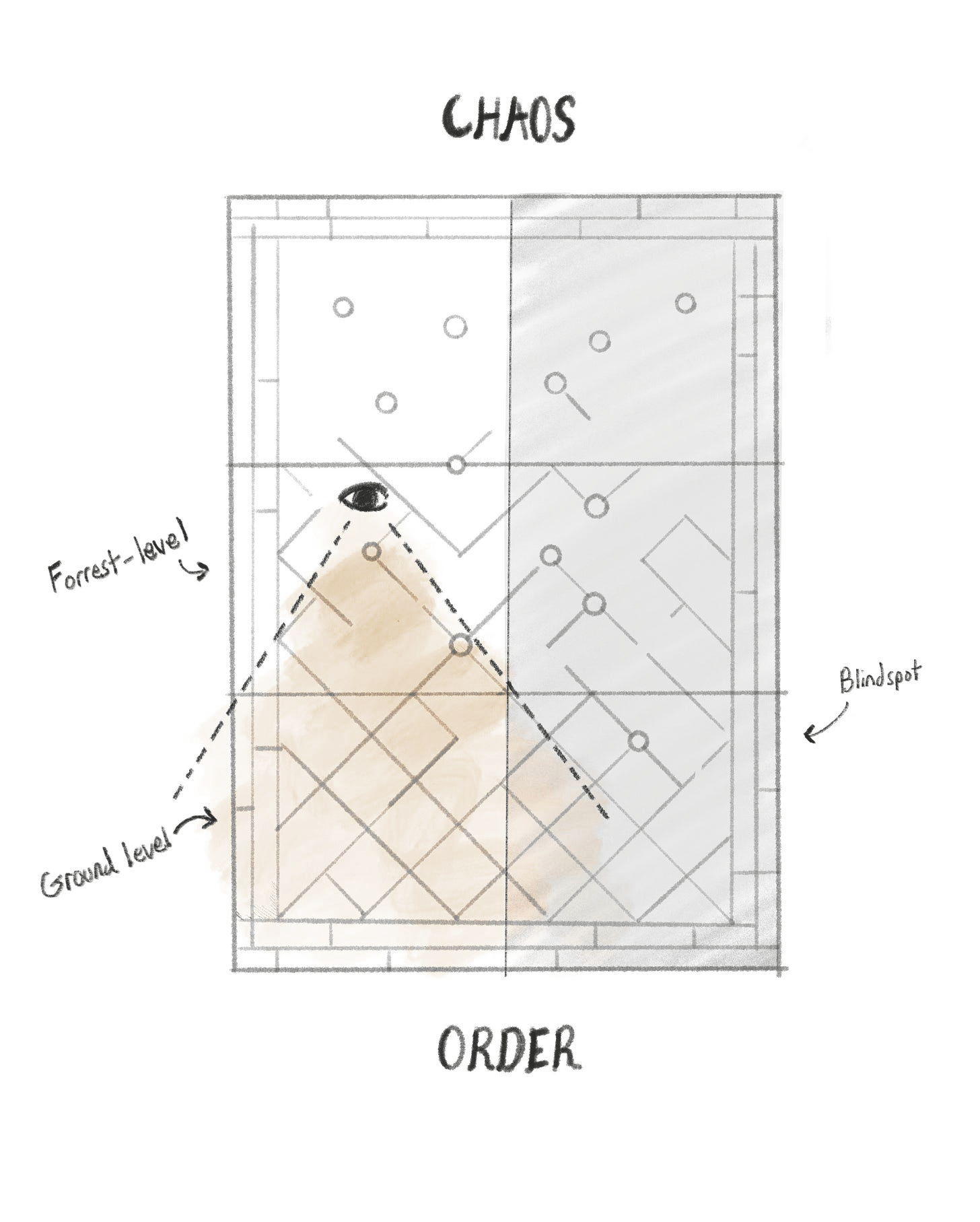
Flipping the gameboard vertically makes this aspect easier to picture:
Cultureland sees the existing relational (and part of conceptual) order from a high level. It’s fuzzy, but broader, more general patterns appear that aren’t visible within Normland or Systemland.
As our mind’s eye floats up from the ground floor to the tree level, we begin to see vague, broader patterns invisible from the ground of everyday life. Here, we can play with ideas and ideals that are part “pie in the sky,” part just-might-work.
As part of the [@link(open=reference) Relational World](/concepts/relational-world/index.md), the view from Cultureland isn’t propositional, scientific, or conceptual. But it’s first to spot opportunities for social change and to rally people to meet them. Conceptual tools typically come into play *downstream* of Cultureland after we care enough to put them to use.
Cultureland is where we play with new, incomplete social patterns: bleeding-edge causes, spiritual practices, revolutionary movements, art forms, memes, and other social expressions. It’s a dramatic, artful mess of ways to relate to one another beyond what’s permitted within the tight borders of [Normland](/essays/welcome-to-normland/index.md).
---
## Cultureland is the epicenter of relational conflict.
As an emergent space, the patterns here are a broad-brushed, mixed bag of social impulses, most of which will never come to pass — but a few change everything. Naturally, this middle space is the epicenter of relational conflict from family-sized squabbles over values, to company cultural realignments, to The Culture Wars.
Unlike orderly spaces — Normland and Systemland — the players and plays in Cultureland are both **inspirational** and **controversial**, depending on where we see them from. Some of the examples in this essay will feel uncomfortable and raise questions. But if an idea or movement isn’t emotionally charged, it’s neither in this space nor in any position to create or evolve anything.[@link(open=reference) 1](/annotations/welcome-to-cultureland/footnote-1/index.md)
A [Normland](/essays/welcome-to-normland/index.md) perspective sees Cultureland’s critiques and ideas as threatening the hard-won social order with half-baked, offensive, and vague ideals. (Meanwhile, those who are on the outskirts of the current social order see it as a glimmer of hope.)
[Systemland](/essays/welcome-to-systemland/index.md) sees the plays here as overly dramatic, romantic, and illogical — not workable. It tends to prescribe more individual and technological solutions to social ills.
Both viewpoints are correct according to the rules and plays of their space, but both are equally limited in perspective too.
Remaining in the middle — with one foot kicking up the hornet’s nest of Social Order while the other grasps for new ground amidst a Chaos of possibilities — is a difficult straddle. Most of us don’t stay long in this headspace, and only a small part of any social group needs to play here. A small dose can go a long way for better or worse.
---
## Three Plays in Cultureland
A stable social and conceptual order is the foundation of any group. Robust plays and players in Normland and Systemland are fundamental. But Order — what reliably works — is stable, not static. It can evolve or decay but can’t remain as is.[@link(open=reference) 2](/annotations/welcome-to-cultureland/footnote-2/index.md) Plays in Cultureland are our vanguard for evolving our relational order to be more varied, supportive, and expansive.
---
### Play I: INVERT
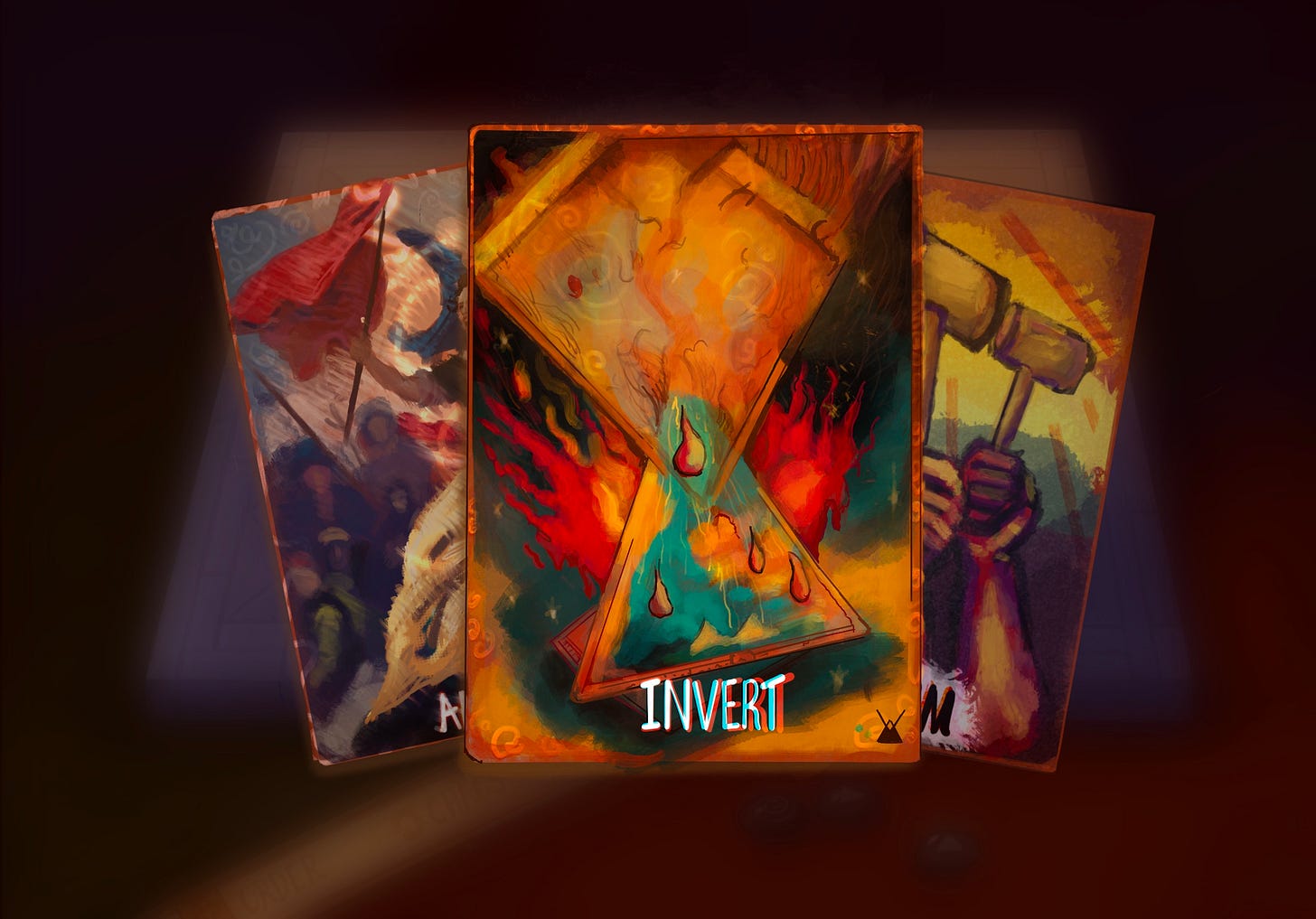
INVERT flips the status quo to reveal absurd social dissonances and provocatively advocates for flipping the social hierarchy.
Each day, we navigate relationships turn by turn — a goodbye to our spouse, then annoyance at a stranger in traffic, then onto navigating political dynamics in a work meeting, and perhaps a polite chat with a barista for coffee.
But when our perspective zooms out to community-wide social patterns, we notice the outliers: the contrasts between the highest status and most disadvantaged; the gap between supposed cultural values and actual practice; the absurdities few around us seem to notice. Each grows more vividly dissonant while the mainstream fades from view.
Just as a technology innovator sees mostly flaws in the existing technology as space for better tech, Cultureland sees flaws in the social order and how to change it.
It doesn’t matter if the current norms have amazingly progressed compared to our ancestors—a higher-altitude view is critical of the present in terms of what *might* be in the future rather than what *has been* in the past.
So the first play made to the right of the status quo is to INVERT it with ironic, unexpected expressions that flip our attention out of the norm space towards people and expressions that are left out or oppressed.
Expressions like avant-garde art and comedy directly challenge the status quo by inverting it to an absurd or disturbing degree (c.f., Banksy’s “Napalm” or comedy roasts[@link(open=reference) 3](/annotations/welcome-to-cultureland/footnote-3/index.md)). More positively, an INVERT play may cleverly reframe a common trope by inverting a colloquialism — For example, Martin Luther King Jr.’s response that “*it’s a cruel jest to say to a bootless man that he ought to lift himself by his own bootstraps.*” [@link(open=reference) 4](/annotations/welcome-to-cultureland/footnote-4/index.md)
Social revolutionary movements like the French Revolution, ancient proclamations like “the first shall be last,” and modern ideas like Critical Race Theory aren’t often invoked in the same sentence. But each is a play to INVERT the established social structures, giving the disadvantaged and oppressed an equal—or *louder*—voice than those higher in the present social hierarchy.
We play INVERT by zooming out to spot social dissonances, then flip them to expose them for what they are. One of my favorite examples is when the KKK took a [blow to the chin from](https://www.inverse.com/entertainment/superman-smashes-the-klan) *[Superman](https://www.inverse.com/entertainment/superman-smashes-the-klan)* in the 1940s. The children’s radio series exposed the absurdity of its secret codewords, rituals, and beliefs.
**A caution:** Inversion creates necessary contrasts to see space for change but without positive solutions. This play “softens the ground” by deconstructing or subverting aspects of the existing order to make space for the new. Inversion is a pointer, not a plan; it’s a risky art, not science. When generalized critiques indiscriminately get applied as practical solutions, we may instead PERVERT our community's nourishing, stable roots.[@link(open=reference) 5](/annotations/welcome-to-cultureland/footnote-5/index.md)
Below are a few worldviews, movements, and people that are — or were at one time — somewhere in the middle space of Cultureland, making INVERT plays. (Keep in mind that the further we move towards Chaos, the more complicated and messy it is to place things.)[@link(open=reference) 6](/annotations/welcome-to-cultureland/footnote-6/index.md)
**A mishmash of old and new INVERT plays and players:**
Anarchism, Jordan Peele movies, socialism, multiculturalism, Jonathan Swift, post-colonialism, the Sermon on the Mount, Picasso, non-violent resistance, Banksy, critical race theory, “roasts,” sex positivity movement, moral relativism, absurdist/anti-comedy, postmodernism, environmental justice, alternative medicine, feminism, mimetic rivalry disruption, queer theory, Robin Hood, The Onion, avant-garde art, “Liberté, égalité, fraternité,” pacifists, Dada movement, body positivity, deconstruction, Michael Moore,...
---
### Play II: AMPLIFY
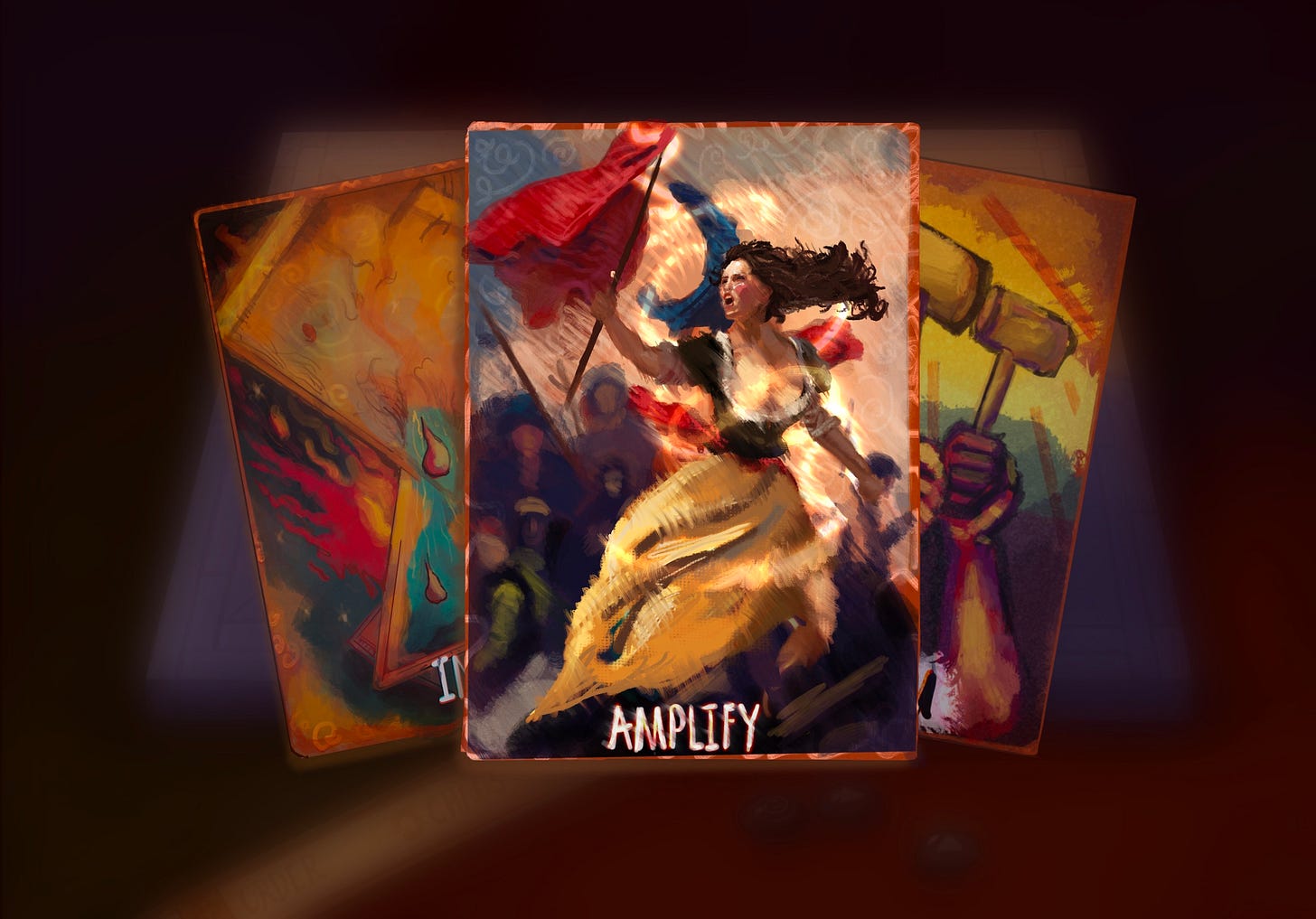
AMPLIFY dials up the volume to expand what’s permitted in polite, normal social expression.
Changing our deeply held beliefs and values is hard enough, let alone changing someone else’s. There’s no exact science for how to go about it, of course, but we could quantify it like this for fun:
“Emotional energy units” (EEUs) required to…
…keep the status quo: **1**
…change it: **1,000+**
The older the tradition, norm, or social hierarchy, the more EEUs it’ll cost. To gain a sliver of a chance at changing things, idealistic visions and criticism must be compelling enough to catch fire on the edge of our social fabric and burn away some space.
Enter the **AMPLIFY** play: it dials up collective feelings for social differences, dissonances, and higher aspirations with dramatic expressions that push people to feel things beyond the window of what’s polite and nice: galvanizing stories, mass protests, startling fashion, new kinds of art, and provocative slogans play on our heartstrings before opening a path to our minds.
“Lips that touch liquor shall not touch ours.”
— Temperance Movement Slogan
Even individual words like “violence” expand provocatively to express more than the mainstream definition can hold. What means active physical harm to most expands to include invisible emotional and psychological harm that may be inflicted by *not* acting. Charged words like “racism” expand beyond explicit prejudicial acts to include unconscious biases and passive participation in unjust systems.
“Silence is violence.”
Broad-brushed amplifications like these naturally create confusion and unease on the ground floor of reality. In everyday interactions with friends, family, and coworkers, using words according to their more literal, common usage is the safer play. However, at a societal level, timely amplification gives a critical spark to expanding ideas like “*all men are created equal*” to include men of all skin colors, then to women too, and later others.
At a less culture-wide scale, amping up what’s uniquely resonant about your product or company just enough and at the right moment differentiates a great brand from a generic one. Artful amplification distinguishes culture-making classic tracks from run-of-the-mill pop music, groundbreaking cinema from popcorn flicks, and innovative art from kitsch.
As covered in the Systemland essay, a common misplay from Systemland is to think that merely [showing the arguments](/essays/welcome-to-systemland/index.md#reading-misplay-just-show-the-args) — the facts, precedents, and rationale — will be enough to change people’s values or beliefs. But those adept at the AMPLIFY play instinctively know that powerful change spreads across the world from artful expression before logical argumentation gets around the block. But amped-up zeal can lead us into another misplay unique to this space:
---
#### Misplay: Progressive Presentism
Uncle Tom’s Cabin was a galvanizing spark for the abolitionist movement and the American Civil War. But for some who look back at it from a modern perspective, it reads as overly simplistic and sentimental while invoking exaggerated, problematic stereotypes. But this shouldn’t surprise us: generalized, exaggerated, and “mixed bag” sentiments are a feature of any emerging social movement that eventually becomes a more mainstream view. Inspect any past social revolution or revolutionary just a little, and you’ll uncover some dirty laundry; the older, the dirtier. The evolving — but imperfect — cycle of social change leaves no doubt that our grandchildren will look back on whatever causes we advocate for as equally messy and problematic as well. But zeal for more progressive ideals can easily create an illusion that our cause is more pure and complete than those that constructed the platform we’re playing on. It’s a kind of naive perfectionism that can block us from making the next play required for real change: REFORM.
> Prompt: How might positively emotive art, music, and stories help open people’s hearts to update their views?
As with any play, there’s also a darker side to AMPLIFY. If we play it too much — or too bluntly — there’s a risk we’ll NEUTRALIZE the very people we set out to emphasize.[@link(open=reference) 7](/annotations/welcome-to-cultureland/footnote-7/index.md)
**A mess of AMPLIFY plays and players, old & new:**
Greta Thunberg, Impressionism, “Silence is violence,” Sit-Ins, “Black Lives Matter,” 1984 (the book and the ad), Iranian protests, Marina Abramović, Bob Dylan, Antifa, “Defund the police,” Punk rock/Grunge, Iconoclasts, Animal Farm, Black Arts Movement, The Art of War, Ingmar Bergman, Rosa Parks, “Believe women,” PETA, The Handmaid’s Tale, Uncle Tom’s Cabin, #MeToo, “Give me liberty or give me death,” Beatniks, “Make love, not war,” Picasso’s Guernica, “Save the children,” The Diary of Anne Frank, …
---
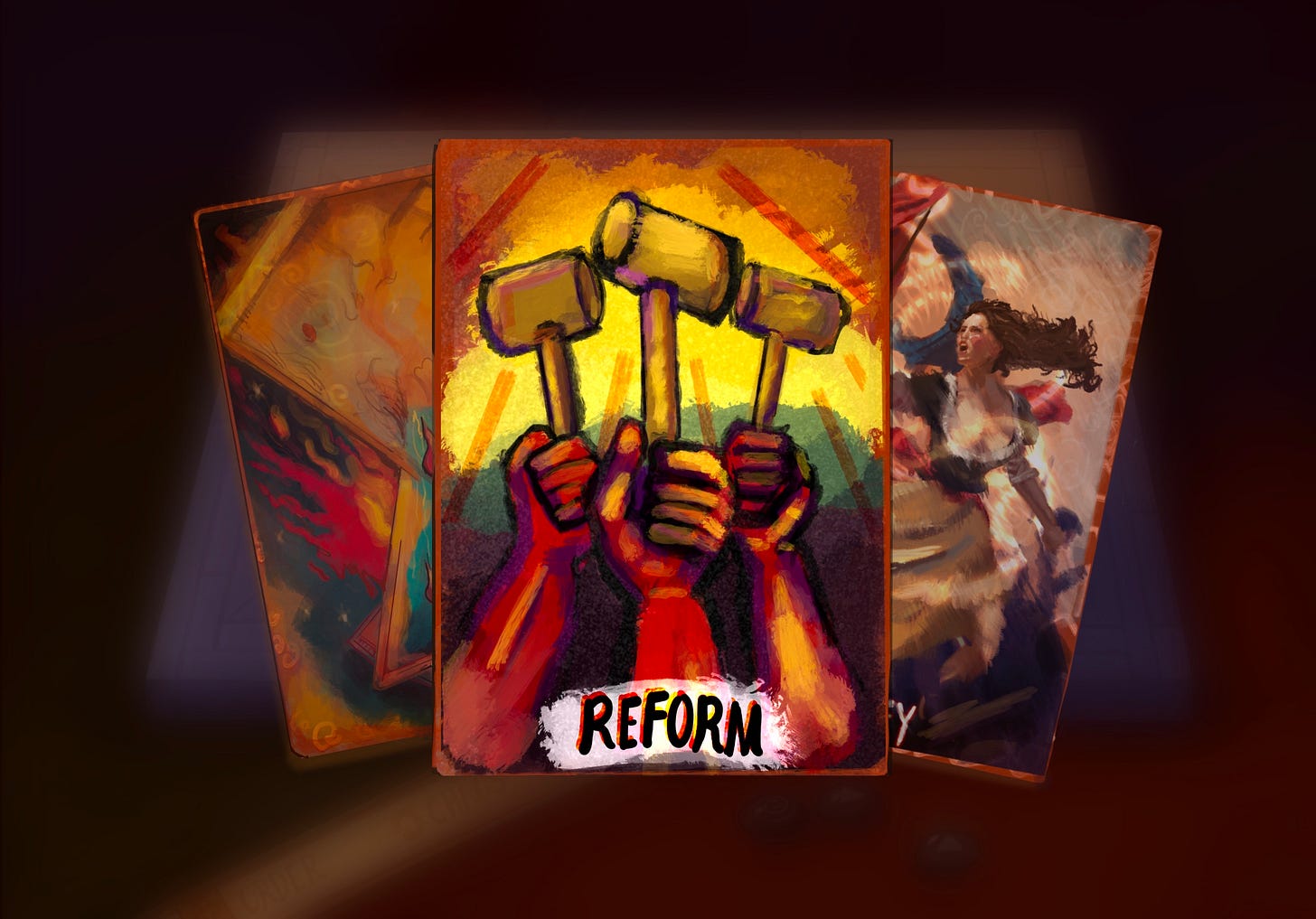
### Play III: REFORM
REFORM translates ideals into advocacy to change the current social order.
INVERT and AMPLIFY can make problematic social structures grow intolerable or at least silly enough that people grow open to change, opening space for REFORM. This play funnels energy from free expressions and social experiments into activism that alters the order of things. But as we approach the rocky, stormy shores of Order, we must negotiate our way carefully or risk a crash.
> *"Activism is my rent for living on this planet."* - Alice Walker
The first set of rocks are the shores of Normland: despite seeing a need for change, the view from here is to look to restore patterns from the glory days of yore: Western Civilization, simpler times, traditional family values, the "good ol' days," and the like.[@link(open=reference) 8](/annotations/welcome-to-cultureland/footnote-8/index.md)
So, part of navigating positive social REFORM is the art of helping folks find their own way to PRESERVE the essence of older values, norms, and traditions while attaching them to healthier, more robust social patterns.
Constructive REFORM requires genuinely seeking common ground with the norms and traditions we often overlook or feel disgusted by. Finding common ground with social order has little to do with reason — it's about shared emotional resonance.
For example, translating amplified, inverted expressions into popular art helps early social adopters latch on to them on the “Fashionable Edge” and take them across the permeable border between Cultureland and Normland.[@link(open=reference) 9](/annotations/welcome-to-cultureland/footnote-9/index.md)
> **Prompt:** if you’re in a position to change a group’s social patterns for the better, can you find common ground in how they express their values, social signals, or aesthetics? How can what you’re advocating for help them live up to *their* own values? If you can’t, you may not have yet reached the starting line.
But there’s another complication: our existing social Order is interwoven and buttressed by the underlying conceptual systems in Systemland. So, to make lasting changes, we must *also* negotiate with and change the laws, facts, and theories underneath. This is best accomplished in partnership with innovative but distinctively impersonal emerging concepts, examined in the tour of [Innovationland](/essays/welcome-to-innovationland/index.md).
Here’s a way to know you’re making a REFORM play: it feels less glamorous and more like intense emotional labor. The intoxicating momentum and excitement from battling into a strategic position to change things dissolve into tedious politics, negotiations, and iterative compromise. If they’re to last, we must reshape, edit, and troubleshoot idealistic notions into practical social patterns that are less exciting than when they were still unrealized.
Persisting in REFORM requires positive faith and iron will that few people muster for long. It’s easier to refuse to negotiate with the social order and retreat into fantastic ideals. Or to make a darker play where we attempt to RECONDITION people to fit our ideals like puppets.[@link(open=reference) 10](/annotations/welcome-to-cultureland/footnote-10/index.md)
**A jumble of old & new REFORM plays and players:**
Mr. Rogers, Noam Chomsky, Martin Luther, Martin Luther King Jr., Greenpeace, Zapatistas, Woman’s Suffrage Movement, Margaret Singer, DEI, Constantine the Great, The Arab Spring, Temperance Movement, Mahatma Gandhi, The Black Panthers, Christianity, Nelson Mandela, Betty Friedan, Che Guevara, The French & American Revolutions, Joseph Smith,…
---
## Conclusion
Let’s consider a practical example of how all these Plays work together: Not so long ago, the notion that women should have the right to vote emerged as a chaotic and unsettling ideal. For millennia, the idea of equal female participation in governance was silly and rarely occurred in serious conversation. The normative view of the statesmen, citizens, and clergy alike was that equalizing the rights of each gender was an attack on the ordained social Order — a dangerous inversion of what God or Nature intended. As art, persuasion, and social protests amplified it into a movement, social order defenders of all genders opposed it as an existential threat:
> *“[Women’s suffrage] are the politics of the very far future. They are too altruistic, idealist and unwanted for the human nature of the present day!” - Mrs. Kate Roosevelt*.
Mrs. Roosevelt was right about one thing, at least: the firings, beatings, and imprisonment faced by advocates for women’s suffrage clearly showed how “unwanted” it was at the time.
Yet, what seemed a distant fever dream amplified and spread as mimetic sparks enflamed people with the potential of a more just citizenship and balanced governance. The sexism woven into our social fabric slowly grew to feel offensive or at least antiquated.
But during the decades it took the movement to spread, it wasn’t fashionable to be a feminist like it is today. It was beyond the edge of Normland in the risky, messy, and isolating space of Cultureland. But here we are, a century later, and women’s right to participate in democracy isn’t merely accepted but normative.
Just like technical innovations, most social revolutions fail. Others succeed only to do more harm than good. But a few improve things and evolve our social patterns to be more expansive, colorful, and robust for future generations to build on.
**Prompts:**
- What modern challenges to the social order seem to you as **realistic** only in the “very far future” and too “altruistic, idealist, and unwanted” for the present day?
- What changes to social Order are you open to or advocating for? Do you have a sense of how to negotiate with the current Order? What are you willing to trade for incremental (but not total) progress?